Table of Contents
ToggleA long, narrow bathroom can feel more like a hallway than a functional space, but it doesn’t have to. These “bowling alley” bathrooms are common in older homes, apartment conversions, and new builds where footprint is tight. The good news? With deliberate planning, a rectangular bathroom can actually work better than a square one. The key is understanding how to arrange fixtures, manage sightlines, and use design tricks that counteract the tunnel effect. This guide walks through layout strategies, fixture choices, and storage solutions that turn a challenging footprint into a well-organized, comfortable bathroom.
Key Takeaways
- A long rectangular bathroom layout naturally divides into functional zones (wet, dry, and grooming areas) that work more efficiently than awkwardly arranged fixtures.
- Choose between a classic three-zone layout (toilet at far end, shower in middle, vanity near door) or a galley-style configuration (fixtures on both long walls) based on your bathroom width and plumbing access.
- Wall-mounted vanities, wall-hung toilets, and curbless walk-in showers save critical inches of depth and create the illusion of more space in narrow bathrooms.
- Horizontal tile patterns, light continuous flooring, and strategic mirror placement visually stretch width and counteract the tunnel effect common in rectangular bathrooms.
- Maximize storage in long rectangular bathrooms using recessed niches, tall narrow cabinets, over-the-toilet organizers, and vertical wall space instead of bulky floor-based units.
- Painting short end walls a slightly darker shade visually pulls them forward, balancing proportions and reducing the perceived length of the space.
Why Long Rectangular Bathrooms Are Both a Challenge and an Opportunity
A rectangular bathroom typically measures anywhere from 5 to 8 feet wide and 10 to 15 feet long, though dimensions vary widely. The challenge is obvious: the space feels narrow, sometimes claustrophobic, and poorly planned layouts amplify that tunnel effect.
But there’s an upside. A linear layout naturally divides into zones, wet, dry, and grooming areas, without requiring partitions or visual breaks. It’s easier to sequence fixtures logically (toilet, shower, vanity) and route plumbing efficiently along one wall. You’re also less likely to have awkward dead corners that are hard to use.
The main pitfall is placing fixtures haphazardly, which creates bottlenecks and wastes the one thing you do have: length. If you treat the space like a corridor instead of a series of zones, you’ll end up with a cramped, unpleasant bathroom no matter how nice the tile is.
Essential Layout Strategies for Narrow Bathroom Spaces
When working with a long rectangular footprint, layout isn’t just about fitting fixtures, it’s about flow, clearances, and psychological comfort. Two proven approaches handle these constraints well.
The Classic Three-Zone Layout
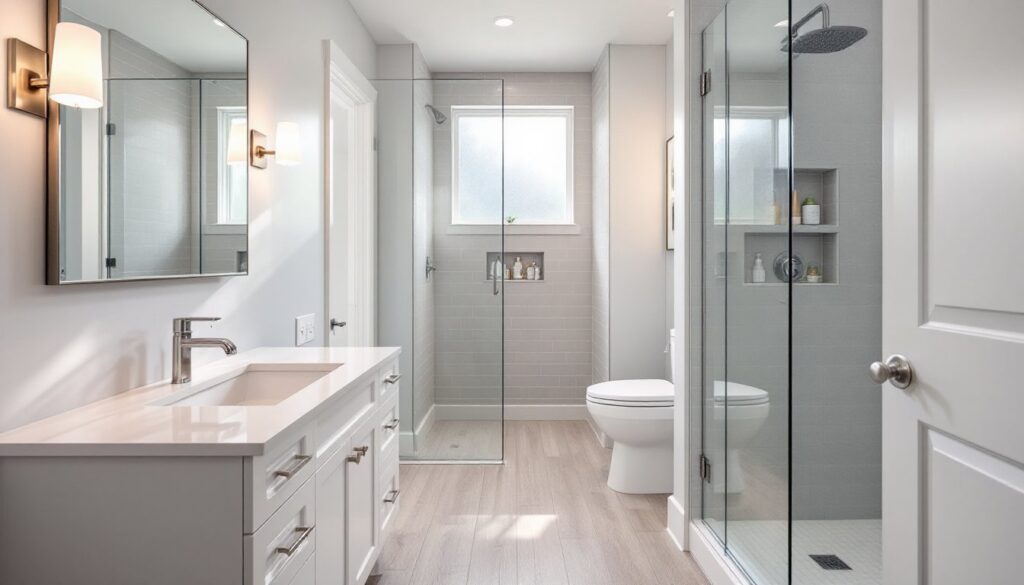
This configuration divides the length into three distinct zones: toilet at the far end, shower or tub in the middle, and vanity near the door. It’s the most common layout for 5-foot-wide bathrooms and works especially well when plumbing is stubbed along one long wall.
Key clearances to respect:
- Toilet: Minimum 15 inches from centerline to any wall or fixture: 21 inches of clear space in front (per IRC).
- Shower: At least 30 × 30 inches interior dimension, though 36 × 48 inches is far more comfortable.
- Vanity: 21 inches of standing space in front: 30 inches wide minimum for a single sink.
Position the toilet at the back for privacy, especially if the door opens directly into the space. Many bathroom remodeling projects focus on optimizing this zone sequence to improve daily flow. A pocket door or barn door saves the 2 feet of swing clearance a standard door eats up, worth considering if width is under 6 feet.
The Galley-Style Configuration
In wider rectangular bathrooms (7+ feet), you can place fixtures on both long walls, galley-kitchen style. Vanity on one side, toilet and shower on the other. This works well when you have plumbing access on two walls or want to create a more symmetrical, less tunnel-like feel.
Advantages:
- Shorter walking distance from door to shower.
- Easier to add double sinks without crowding.
- Better ventilation and natural light distribution if windows are on the short walls.
Trade-off: You lose some of that zoned privacy. A separate toilet compartment (water closet) can solve this, but it requires a 30-inch-wide by 60-inch-deep footprint minimum, check local code.
Design Tricks to Make Your Long Bathroom Feel Wider
Layout solves function: design solves perception. A few deliberate choices can make a narrow bathroom feel significantly more open.
Horizontal lines and patterns: Run tile, shiplap, or wainscoting horizontally across the short walls. This visually stretches width. Avoid vertical subway tile in a 3 × 12-inch format, it emphasizes height and makes the space feel narrower. If you love subway tile, lay it horizontally or in a herringbone pattern instead.
Light, continuous flooring: Use the same tile throughout, and run planks (if using luxury vinyl plank or wood-look tile) perpendicular to the length. A 12 × 24-inch tile in a straight lay, running width-wise, reads as wider. Avoid dark grout lines running lengthwise, they’re visual speedbumps that exaggerate the tunnel.
Mirror placement: A full-width mirror above the vanity reflects light and doubles perceived width. If budget allows, mirror one entire short wall (the one opposite the door). This is especially effective in galley layouts. Skip narrow vertical mirrors, they do nothing for proportion.
Lighting strategy: Recessed cans spaced evenly down the center create a runway effect. Instead, use wall sconces on both long walls and a single flush-mount or linear fixture over the vanity. Horizontal light sources widen the space visually. Many interior design guides emphasize layered lighting to reduce shadows and improve spatial perception.
Color and contrast: Light walls are standard advice, but don’t stop there. Paint the short end wall (where the toilet sits) a shade or two darker. This “pulls” that wall forward visually, shortening the perceived length and balancing proportions.
Fixture Selection and Placement for Rectangular Bathrooms
In a narrow bathroom, every inch of fixture depth matters. Standard vanities are 21 inches deep: wall-hung or shallow models go as slim as 16 inches. That 5-inch difference can be the margin between comfortable and cramped.
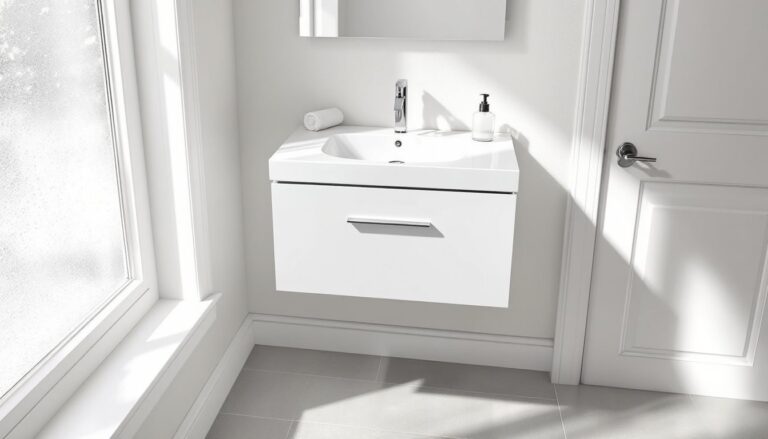
Vanities: A wall-mounted vanity creates the illusion of more floor space and simplifies cleaning. If you need storage, choose a model with drawers rather than doors, drawers are easier to access in tight quarters. For double sinks, you’ll need at least 60 inches of width: if that’s not available, a single 30- or 36-inch vanity with a side cabinet works better than crowding two sinks.
Toilets: A wall-hung toilet saves 4 to 6 inches of depth compared to a standard floor-mount, and the concealed tank system (like Geberit or Toto in-wall units) hides plumbing. Installation is more complex, requires opening the wall and reinforcing framing, but the visual and spatial payoff is significant. Alternatively, an elongated bowl is more comfortable than a round one, but only if you have the clearance.
Showers and tubs: Skip the tub if you don’t use it. A curbless walk-in shower with a linear drain feels more open and eliminates a physical barrier. If code and subfloor structure allow, this is one of the best moves for a narrow bathroom. Frameless glass (or no door at all, if the shower is at the far end) maintains sightlines and avoids visual clutter.
If a tub is non-negotiable, a standard 60-inch alcove tub fits most 5-foot-wide bathrooms, but consider a Japanese-style soaking tub (shorter length, deeper) to free up floor space elsewhere. Always check rough-in dimensions before ordering, most toilets need a 12-inch rough-in, but older homes may have 10- or 14-inch, which limits fixture options.
Storage Solutions That Work in Tight, Linear Spaces
Storage is the Achilles’ heel of narrow bathrooms. There’s rarely room for a linen closet, and bulky cabinets make the space feel even tighter. The solution is vertical storage and smart use of dead zones.
Recessed shelving: If you’re remodeling and walls are open, frame in a recessed niche between studs (typically 14.5 inches wide in a 2×4 wall, 22.5 inches in a 2×6 wall). Place it in the shower for toiletries or beside the toilet for extra rolls and reading material. Depth is only 3.5 to 5.5 inches, but it’s space that didn’t exist before, and it doesn’t project into the room.
Tall, narrow cabinets: A floor-to-ceiling cabinet that’s 12 to 18 inches wide can fit beside the vanity or at the end of the room. Choose a shallow depth (12 inches max) to avoid encroaching on clearances. Open shelving works too, but only if you’re committed to keeping it organized, visual clutter in a narrow space is a problem.
Over-the-toilet storage: Ladder shelves or wall-mounted cabinets above the toilet use vertical space that’s otherwise wasted. Make sure the unit doesn’t interfere with tank access or flushing mechanisms. Avoid cheap particle-board units in a bathroom, moisture will warp them. Look for moisture-resistant MDF, solid wood, or metal.
Vanity organization: Maximize what you have. Drawer dividers, pull-out trays, and under-sink organizers (U-shaped to clear the plumbing) turn chaotic cabinet space into usable storage. If you’re building custom, specify full-extension drawer slides, they allow access to the entire drawer, not just the front two-thirds.
Hooks and rails: Don’t underestimate the power of wall-mounted hooks for towels and robes. They’re faster to use than towel bars and take up zero floor space. A picture rail or peg rail along one wall adds character and function. When planning a remodel, explore design inspiration and storage ideas to see how other homeowners handle similar constraints.
One last tip: avoid storing anything on the floor. It breaks up sightlines and makes the room look smaller and cluttered. If it doesn’t hang or fit in a cabinet, it doesn’t belong in a narrow bathroom.