Table of Contents
ToggleShopping for a bathroom vanity means navigating dozens of configurations, finishes, and price points, and Lowe’s stocks one of the broadest selections available to homeowners today. Whether someone’s tackling a half-bath refresh or a full primary suite remodel, the right vanity anchors the space functionally and visually. This guide walks through what Lowe’s offers, how to match a vanity to the room’s dimensions and plumbing layout, and when to call in help versus rolling up sleeves for a DIY install.
Key Takeaways
- Lowe’s bathroom vanity selection ranges from budget-friendly Allen + Roth models ($250–$400) to premium solid-wood options ($1,500–$4,000+), accommodating any remodel budget and style preference.
- Proper sizing and measurements are critical—account for wall clearances, depth constraints (typically 21 inches standard), and height preference (comfort height at 36 inches vs. traditional 30–32 inches) to ensure a functional fit.
- Freestanding vanities are simplest for DIY installation, while wall-mounted and double vanities may require plumbing relocation, structural reinforcement, or a licensed contractor, especially if the existing rough-in doesn’t align.
- Lowe’s offers convenient services including 90-day returns, delivery, and professional installation ($200–$600 for standard swaps), plus special orders that typically arrive within 2–3 weeks for non-stocked sizes.
- Common DIY pitfalls—overtightening compression nuts, improper wall mounting, and failing to verify supply and drain alignment before installation—can be avoided with careful dry-fitting and basic hand tools.
Why Choose Lowe’s for Your Bathroom Vanity?
Lowe’s carries vanities from budget-conscious builders to mid-range name brands, with in-store inventory that lets buyers see finish quality and hardware operation firsthand. Online selections expand further, including exclusive lines not stocked on shelves.
Stock availability matters when a project timeline is tight. Many Lowe’s locations keep popular 24-inch, 30-inch, and 36-inch single-sink models in stock, along with coordinating faucets and mirrors. For less common sizes, like a 48-inch offset-sink vanity or a 72-inch double, special order through Lowe’s typically arrives within two to three weeks, depending on the manufacturer.
Delivery and assembly options simplify logistics. Lowe’s offers truck delivery for larger vanities, and some stores provide installation services through vetted local contractors. Pricing for install varies by region and scope, but having one vendor coordinate product and labor can streamline permitting and warranty claims if issues arise.
The return policy provides a safety net: most vanities qualify for 90-day returns with a receipt, giving homeowners time to dry-fit the unit and confirm it works with existing plumbing rough-in before final installation.
Types of Bathroom Vanities Available at Lowe’s
Lowe’s inventory spans several vanity categories, each suited to different layouts, plumbing configurations, and aesthetic goals.
Single vs. Double Vanities
Single-sink vanities range from compact 18-inch powder-room models up to 48-inch units with ample drawer storage. Typical widths, 24, 30, 36, and 48 inches, align with standard cabinet increments, making them easier to fit between existing walls or next to a tub alcove. A 36-inch single vanity offers a comfortable countertop workspace and usually includes one bank of drawers plus a false drawer front beneath the sink bowl.
Double-sink vanities start at 60 inches wide and commonly run 72 inches, which requires at least that much clear wall space plus code-mandated clearance in front (typically 30 inches from the cabinet face to any opposite wall or fixture, per IRC). Plumbing rough-in for doubles means two drain assemblies and two supply risers: if the existing bathroom has only one drain stack, rerouting waste lines through the floor or wall becomes necessary, often a job for a licensed plumber.
Double vanities shine in shared bathrooms, eliminating morning bottlenecks, but they demand more countertop depth to avoid a cramped feel. Most doubles sit on 21-inch-deep cabinets, compared to 18 inches for many singles.
Freestanding, Wall-Mounted, and Vessel Options
Freestanding vanities rest on legs or a toekick base, concealing plumbing inside the cabinet. They’re the easiest to install since they don’t require fastening to wall studs for support, gravity and a bead of caulk along the back edge hold them in place. Freestanding units also simplify future replacement: just shut off the water, disconnect supply lines and the P-trap, and slide the old vanity out.
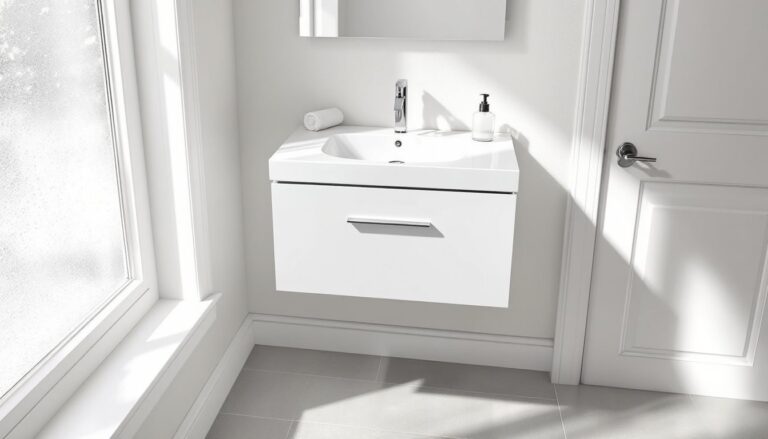
Wall-mounted (floating) vanities attach directly to studs with a cleat or French-cleat system, leaving open floor space beneath. That visual lightness suits small bathrooms, and the gap underneath makes tile or vinyl plank installation cleaner since there’s no need to notch flooring around a cabinet base. The tradeoff: wall-mount installation requires locating studs, typically 16 inches on center, and may need blocking added between studs if the vanity’s hanging bracket doesn’t align. Always verify wall framing can support the combined weight of the cabinet, countertop, and a full sink (water weighs about 8 pounds per gallon).
Vessel-sink vanities pair a countertop, often a single slab of stone, wood, or engineered material, with an above-counter basin. Lowe’s stocks vessel combos and standalone tops that accept a separately purchased bowl. Vessel installs demand taller faucets (usually 8 to 12 inches from counter to spout) and careful height planning: the vessel rim typically lands 36 to 38 inches off the floor, higher than a standard undermount setup, which some users find awkward. On the plus side, swapping a vessel sink later is straightforward since it sits on top rather than being glued and caulked underneath.
How to Choose the Right Size and Style for Your Space
Measure the available wall width first, then subtract clearances: at minimum, leave 2 inches between the vanity edge and any adjoining wall, shower surround, or toilet flange to allow doors and drawers to open fully and to provide access for cleaning.
Depth matters as much as width. Standard vanity depth is 21 inches, but narrow “slim” models at 16 or 18 inches fit tight powder rooms or hallway baths. Going deeper than 21 inches eats into the room: building codes (IRC R307.1) generally require 30 inches of clear space in front of any fixture, so a 24-inch-deep vanity in a 5-foot-wide bathroom leaves just 30 inches of aisle, code-compliant but snug when the door swings in.
Height has shifted over the past decade. Traditional vanities sat at 30 to 32 inches (often called “furniture height”), but many current models default to 36 inches, “comfort height”, which reduces bending for taller users and aligns the counter with standard kitchen-cabinet ergonomics. If the household includes children or shorter adults, test the sink height in-store by mimicking handwashing posture.
Style cohesion ties the vanity to flooring, trim, and fixture finishes. A Shaker-style vanity with recessed-panel doors complements both farmhouse and transitional aesthetics: pair it with brushed-nickel or matte-black hardware to echo faucet and towel-bar finishes. Modern slab-door vanities, flat fronts, minimal hardware, suit contemporary spaces and often come in high-gloss or matte lacquer that’s easy to wipe down but shows fingerprints.
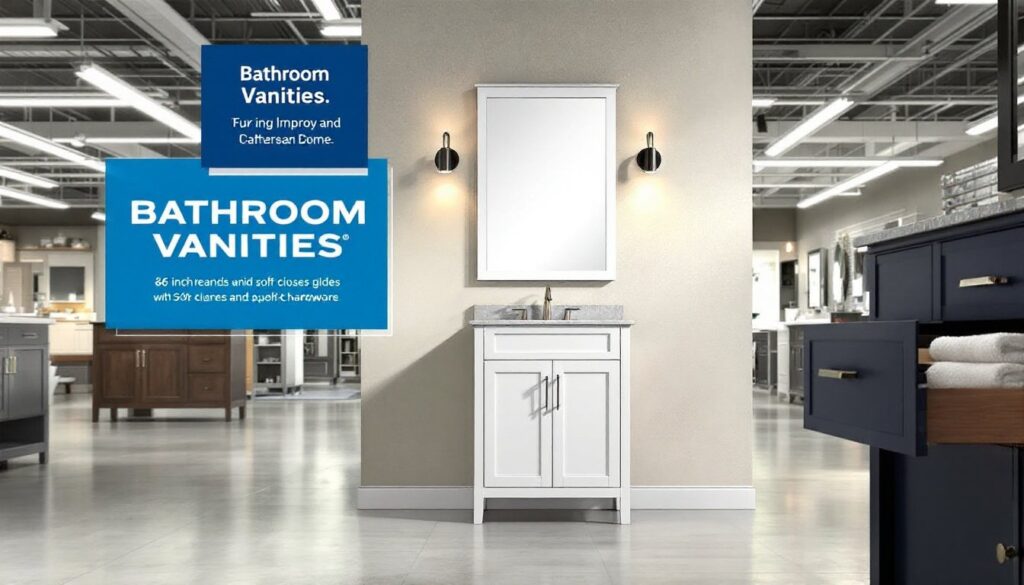
For those seeking design inspiration across price points, mixing textures, wood cabinetry with a quartz top, for instance, adds depth without clashing. Lowe’s vanity displays group coordinating mirrors, lighting, and hardware, making it easier to visualize a complete look before buying individual pieces.
Popular Lowe’s Vanity Brands and Price Ranges
Lowe’s house brand, Allen + Roth, dominates the budget-to-midrange segment. A 30-inch Allen + Roth single vanity with a cultured-marble top typically runs $250 to $400, including pre-attached bowl and backsplash. Construction quality is particle-board or MDF carcass with a thermofoil or wood-veneer finish, fine for guest baths with light use, less ideal for humid primary baths unless the room has a reliable exhaust fan (aim for at least 50 CFM per IRC M1507.4).
Style Selections, another Lowe’s exclusive, offers similar pricing but leans toward trendier finishes: navy blue, sage green, or two-tone combinations. Drawer boxes are often stapled rather than dovetailed, so gentle use extends longevity.
Mid-tier national brands, Kohler, American Standard, and Foremost, appear in the $500 to $1,200 range for single vanities and $1,200 to $2,500 for doubles. Kohler vanities frequently include solid-wood face frames and soft-close hinges: their Poplin and Tailored lines feature furniture-grade finishes and come with a limited warranty covering manufacturing defects for one year.
At the upper end, Bellaterra Home and James Martin Vanities bring solid-wood construction, stone or genuine-marble tops, and hand-applied finishes. Expect $1,500 to $4,000+ for a 60-inch double. These vanities often ship unassembled or partially assembled: budget an extra hour or two for putting together drawer glides and attaching legs.
Lowe’s also stocks semi-custom and ready-to-assemble (RTA) lines like Continental Cabinets and Project Source, where buyers can mix cabinet widths, say, a 24-inch vanity base next to a 12-inch linen tower, to fill non-standard wall spans. RTA pricing hovers around $150 to $300 per cabinet, excluding countertop and sink, making it cost-effective for odd layouts but requiring more hands-on assembly.
For a curated look at minimalist options, some homeowners pair an RTA cabinet with a custom stone top from a local fabricator, balancing Lowe’s convenience for the base with artisan countertop work.
Installation Tips: DIY vs. Professional Help
DIY installation is feasible if the new vanity matches the old unit’s footprint and the existing plumbing lines up with the new sink’s drain and faucet holes. Most freestanding vanities install in three to four hours with basic tools: an adjustable wrench, channel-lock pliers, a level, a stud finder, and a drill/driver with a hole saw for running supply lines through the back panel if factory knockouts don’t align.
Step-by-step outline:
- Shut off water at the fixture shutoff valves or the main if no local valves exist. Open the faucet to relieve pressure and drain residual water.
- Disconnect supply lines (usually ⅜-inch compression fittings) and the P-trap. Keep a bucket handy: trapped water will spill.
- Remove the old vanity. If it’s caulked or screwed to studs, cut the caulk bead with a utility knife and back out screws before sliding the cabinet away from the wall.
- Check the floor for level. Shim the new vanity as needed, wooden shims under the toekick work, but avoid stacking more than two or the cabinet will rack. A ¼-inch variance over 3 feet is acceptable: beyond that, consider leveling compound on the subfloor.
- Dry-fit plumbing. Slide the vanity into place and verify that supply risers and the drain tailpiece align with the new sink’s configuration. Offset or wall-mount faucets may require replumbing.
- Secure the vanity. Freestanding units only need a bead of caulk along the back edge and sidewalls. Wall-mount vanities require lag screws or heavy-duty anchors into studs.
- Attach the faucet and drain to the sink before setting the top (if separate). Working overhead inside a cabinet is cramped: assembling the faucet on a workbench saves knuckles.
- Connect supply lines and trap, then turn water back on slowly, checking for leaks at every joint. Tighten compression nuts another quarter-turn if seepage appears: don’t overtighten or the ferrule may crack.
- Seal edges with a thin bead of silicone caulk (not latex) where the backsplash meets the wall and where the vanity sides meet adjacent surfaces.
Safety gear: Wear safety glasses when cutting or drilling, and use a dust mask if modifying cabinetry, MDF dust is fine and lung-irritating.
When to hire a pro:
- Plumbing relocation. Moving drain or supply lines inside walls or floors often requires a permit and a licensed plumber. Incorrectly vented drains can siphon traps dry, allowing sewer gas into the house.
- Electrical work. Adding or relocating vanity lights, GFCI outlets, or exhaust-fan switches falls under NEC jurisdiction (National Electrical Code): many localities mandate licensed electricians for anything beyond simple fixture swaps.
- Heavy or complex vanities. A 72-inch double with a stone top can weigh 300+ pounds. A second pair of hands, or a pro crew with lifting equipment, prevents back injuries and cracked countertops.
- Water damage or mold. If removing the old vanity exposes rot, mold, or compromised subfloor, pause the project. Remediation and structural repair belong in a professional’s scope, and proceeding without addressing these issues will undermine the new vanity’s longevity.
Lowe’s installation service quotes typically include plumbing hookup, leveling, and haul-away of the old unit. Pricing varies by market, expect $200 to $600 for a straightforward single-vanity swap, more if new shutoff valves or drain fittings are needed. Comparing that fee against the time and tool investment of DIY makes sense, especially for first-time installers.
Online galleries showcasing various installations often highlight details like tile transitions and trim work that signal whether a project stayed DIY-friendly or required professional carpentry and tile-setting to achieve a polished result.