Table of Contents
ToggleHard water’s a menace, it leaves scale on faucets, makes soap less effective, and shortens the life of water-using appliances. If you’re tired of scrubbing white deposits off everything and replacing water heaters prematurely, a water softener is the fix. Novo water softeners have gained traction among homeowners looking for a reliable, moderately priced solution to water hardness. This guide walks through what Novo systems offer, how to pick the right model, and what you need to know about installation and upkeep.
Key Takeaways
- A Novo water softener removes hardness minerals using ion-exchange technology, preventing scale buildup and extending the life of appliances by 10–15 years.
- Properly sizing your Novo system is critical—calculate daily grain capacity by multiplying household size, daily usage (75 gallons per person), and water hardness level to avoid premature regeneration.
- Demand-initiated regeneration (DIR) reduces salt and water usage by 20–40% compared to timer-based units, regenerating only when necessary.
- Installation is a DIY-viable project for experienced homeowners with basic plumbing skills, though hiring a professional ($300–$600) is recommended if your plumbing is in tight spaces or local codes require licensed work.
- Monthly salt checks, annual resin cleaning, and regular hardness testing keep your Novo water softener running efficiently and extend its lifespan to 10–15+ years.
What Is a Novo Water Softener and How Does It Work?
A Novo water softener is an ion-exchange system that removes calcium and magnesium ions, the minerals that cause hard water, from your household water supply. The unit contains a resin tank filled with small polystyrene beads coated in sodium ions. As hard water flows through the resin, calcium and magnesium ions bond to the beads, displacing sodium into the water. The result is softened water that won’t leave scale buildup.
Novo systems operate on a regeneration cycle, typically triggered by a timer or a metered valve that tracks water usage. During regeneration, a brine solution (salt water) flushes through the resin tank, washing away accumulated hardness minerals and recharging the beads with sodium. The discharge water, containing calcium, magnesium, and excess brine, is sent to a drain. This cycle repeats as needed, usually every few days depending on water hardness and household consumption.
Most Novo models use demand-initiated regeneration (DIR), which only regenerates when necessary rather than on a fixed schedule. This conserves salt and water compared to older timer-based units. The control head monitors flow and hardness removal capacity, then triggers regeneration during low-usage periods (typically overnight).
Novo units are whole-house systems, installed on the main water line after the pressure tank (if you’re on a well) or after the main shutoff valve (on municipal supply). They don’t treat water at the point of use, every tap in the house gets softened water, except outdoor spigots, which are often bypassed to avoid wasting soft water on landscaping.
Key Features and Benefits of Novo Water Softeners
Novo softeners come with several features that make them competitive in the mid-tier market:
- Digital control heads: LCD displays show system status, salt levels, and regeneration schedules. Some models allow you to adjust hardness settings and view water usage stats.
- High-capacity resin tanks: Ranging from 32,000 to 64,000 grains, sized to match household water consumption. Larger tanks mean fewer regeneration cycles.
- Efficient salt usage: DIR technology means the unit only uses salt when it actually needs to regenerate, reducing annual salt costs by 20–40% compared to timer models.
- Bypass valve included: Lets you route water around the softener for maintenance or emergencies without shutting off the whole house.
- Pre-filled resin tanks: Units ship with resin already installed, cutting setup time.
The benefits of running a Novo system extend beyond cleaner fixtures. Softened water improves soap lathering, so you use less detergent and shampoo. Appliances like dishwashers, washing machines, and tankless water heaters last longer because they’re not accumulating scale. Water heaters, in particular, see efficiency gains, scale buildup on heating elements can increase energy use by 20–30%.
Clothing washed in soft water stays brighter and feels softer because minerals aren’t binding to fabric fibers. Skin and hair often feel less dry since soap rinses more completely. If you’ve dealt with itchy skin or dull hair in a hard-water area, switching to soft water can make a noticeable difference.
One consideration: softened water has a slightly higher sodium content. For most people this is negligible, but if you’re on a strict low-sodium diet or have a medical condition requiring sodium restriction, consult your doctor. Installing a reverse-osmosis (RO) system at the kitchen tap removes sodium and other dissolved solids if needed.
Choosing the Right Novo Water Softener Model for Your Home
Sizing a water softener correctly is critical, undersized units regenerate too often and wear out faster, while oversized units waste salt and water.
Start by determining your water hardness in grains per gallon (gpg). You can get a test kit from a hardware store or request a water quality report from your municipal supplier. Well water owners should test annually since hardness can vary. Most U.S. households have hardness between 7–15 gpg: anything above 7 gpg benefits from softening.
Next, estimate daily water usage. The average person uses about 75 gallons per day. Multiply by the number of people in your household, then multiply by your hardness level in gpg. That gives you the daily grain capacity you need. For example, a family of four with 10 gpg hardness:
4 people × 75 gallons/day × 10 gpg = 3,000 grains per day
Choose a softener with a capacity that handles at least three days of usage before regenerating. In this case, a 32,000-grain unit would regenerate about every 10 days (32,000 ÷ 3,000 ≈ 10.6 days), which is ideal. Novo offers models in 32k, 48k, and 64k grain capacities.
Larger households or those with very hard water (above 15 gpg) should consider a 48,000- or 64,000-grain model. Oversizing slightly is fine, it means less frequent regeneration, but don’t go more than double your calculated need, or the resin sits too long between cycles and can foul.
Also check your home’s plumbing size. Most residential systems use 1-inch or 3/4-inch supply lines. Novo units typically have 1-inch ports: if your home has 3/4-inch plumbing, you’ll need reducing fittings. Flow rate matters too, if you have high simultaneous demand (multiple showers, irrigation, etc.), ensure the softener’s flow rating (measured in gallons per minute, or GPM) exceeds peak household demand. Novo mid-range models typically handle 10–12 GPM, sufficient for most homes.
Installation and Setup: DIY or Professional Help?
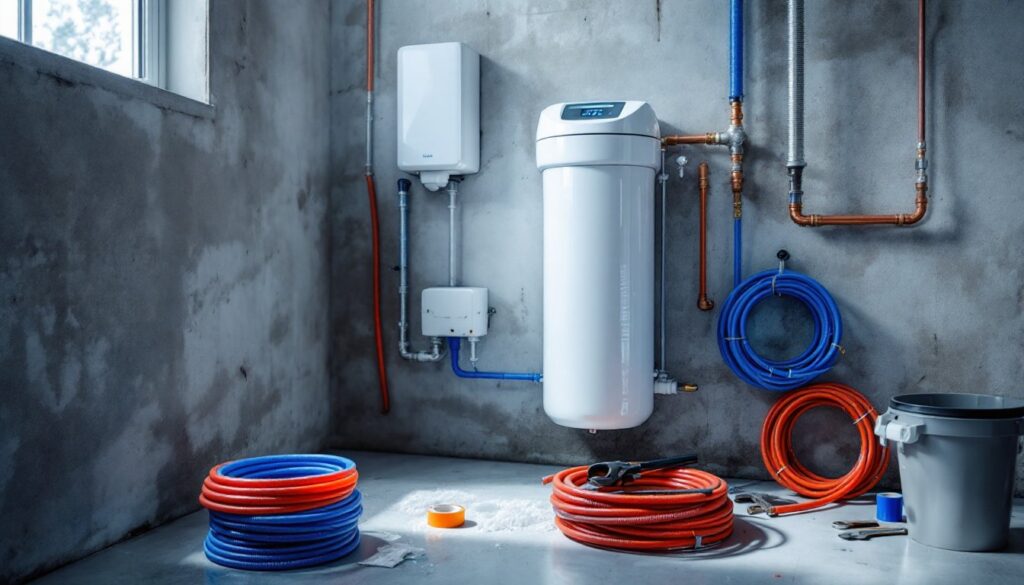
Installing a Novo water softener is within reach for a homeowner comfortable with plumbing, but it’s not a beginner project. You’ll need basic plumbing skills, a few specialized tools, and a half-day’s work.
Tools and materials you’ll need:
- Pipe cutter or hacksaw (for copper or PEX)
- Adjustable wrenches
- Teflon tape or pipe thread sealant
- Compression or push-to-connect fittings (depending on pipe type)
- Drill and hole saw (for drain line routing)
- Level
- Bucket and towels (you’ll spill some water)
- Safety glasses (cutting pipe can send debris flying)
Basic installation steps:
- Shut off the main water supply and drain the lines by opening the lowest faucet in the house.
- Choose a location near the main water line, a drain, and a power outlet. The unit needs a level floor and at least 10 inches of clearance above for salt loading. Basements, utility rooms, or garages are typical spots.
- Cut into the main line where the softener will be installed. You’ll need to install a bypass loop with shutoff valves on the inlet and outlet sides. Novo units include a bypass valve, connect it according to the manual.
- Run a drain line from the softener’s drain fitting to a floor drain, standpipe, or laundry sink. The line must have an air gap (typically 1.5–2 inches) to prevent backflow, per plumbing codes. Use 1/2-inch tubing: it should slope continuously downward.
- Connect the overflow brine line from the brine tank to the control head. This is a small tube that recycles brine during regeneration.
- Plug in the unit (most Novo models use standard 120V outlets) and set the water hardness level on the control head.
- Fill the brine tank with salt (sodium chloride pellets or potassium chloride). Add enough to fill about two-thirds of the tank.
- Manually initiate a regeneration cycle to prime the system, then check all connections for leaks.
If your home has copper or CPVC plumbing, you’ll need soldering equipment or CPVC cement, push-to-connect fittings (SharkBite-style) simplify this but cost more. PEX systems are the easiest: just use crimp or expansion fittings.
When to call a pro:
If your main line is in a tight crawlspace, if local codes require a licensed plumber for alterations to the main water supply, or if you’re uncomfortable sweating copper, hire out. Installation labor typically runs $300–$600 depending on complexity and regional rates. Some municipalities require a plumbing permit for water softener installation, check with your local building department before starting.
Many homeowners find plumbing installation guides helpful when tackling projects that involve modifying existing lines.
Maintenance Tips to Keep Your Novo System Running Smoothly
Water softeners are low-maintenance, but a few routine tasks keep them efficient and extend their lifespan.
Salt management:
Check the brine tank monthly. Keep it at least one-third full, but don’t overfill, salt should stay below the water line to dissolve properly. Use solar salt pellets or evaporated salt pellets, not rock salt, which contains impurities that can clog the system. Potassium chloride is an alternative if you want to avoid sodium, though it costs roughly double.
Every 6–12 months, inspect for salt bridges, a hard crust that forms above the water, preventing new salt from dissolving. If you see one, break it up with a broom handle. Also watch for salt mushing, a sludge layer at the tank bottom. If it occurs, scoop out the sludge and flush the tank.
Resin bed care:
Once a year, add a resin cleaner (iron remover) to the brine tank and run a manual regeneration. This prevents iron buildup, which can coat resin beads and reduce capacity. If you have high iron content (above 0.3 ppm), do this every 3–4 months. Products like Res-Up or Iron Out are widely available.
Filter and valve checks:
If your Novo model has a sediment pre-filter, replace or clean it per the manual’s schedule (typically every 3–6 months). A clogged filter reduces flow and forces the system to work harder.
Inspect the bypass valve and drain line fittings annually for leaks or mineral buildup. Tighten connections if needed.
Control head settings:
If your water hardness changes (common with well water), retest and update the hardness setting on the control head. This ensures the unit regenerates at the right intervals.
Power outages can reset some control heads. If your unit loses its programming, you’ll need to re-enter hardness settings and time. Models with battery backup avoid this issue.
For homeowners managing multiple systems, seasonal maintenance checklists can help keep track of tasks across heating, cooling, and water treatment equipment.
Common Issues and Troubleshooting Solutions
Even well-maintained softeners occasionally develop issues. Here’s how to diagnose and fix the most common problems.
Hard water breakthrough:
If you notice scale returning, white spots on dishes, soap scum, the softener isn’t removing hardness. Possible causes:
- Empty or low salt tank: Refill and run a manual regeneration.
- Salt bridge or mush: Break up the bridge or clean out sludge, then regenerate.
- Incorrect hardness setting: Retest your water and adjust the control head.
- Exhausted resin: After 10–15 years, resin beads lose capacity and need replacement. Resin replacement kits cost $75–150 and are DIY-friendly.
Softener won’t regenerate:
Check that the unit has power (look for display lights). Inspect the drain line for kinks or clogs, if backpressure is too high, the control head may abort regeneration. Make sure the bypass valve is in the “service” position, not “bypass.”
If the control head shows error codes, consult the manual. Common codes indicate low salt, motor failure, or valve jams.
Low water pressure:
If pressure drops after installing the softener, the unit may be undersized for your flow demand, or a sediment filter is clogged. Check the filter first. If pressure is still low, the resin tank may have fouled resin or channeling (water flowing through a narrow path instead of evenly through the bed). Running a resin cleaner or replacing the resin usually resolves this.
Salty-tasting water:
This means brine is leaking into the softened water, often due to a stuck brine valve or a malfunctioning drain cycle. Manually regenerate the unit and check if the problem clears. If not, the control valve may need servicing or replacement, this is a job for a technician.
Continuous water running to drain:
Indicates the drain line valve isn’t closing after regeneration. Unplug the unit, inspect the drain line for obstructions, and check the valve for debris. If you can’t clear it, a service call is warranted.
For additional troubleshooting resources on home systems, appliance repair guides often cover water softeners alongside other common household equipment.
Conclusion
A Novo water softener offers a practical, mid-priced solution to hard water issues that plague many homes. Picking the right capacity, installing it correctly (or hiring a pro when needed), and staying on top of basic maintenance will keep it running efficiently for years. Whether you’re protecting appliances, improving water quality for daily use, or just tired of scrubbing scale, a well-chosen softener pays for itself in extended equipment life and reduced cleaning hassle.